There’s a version of AI-assisted product management that’s just “ChatGPT writes my PRD.” That’s not what I’m talking about.
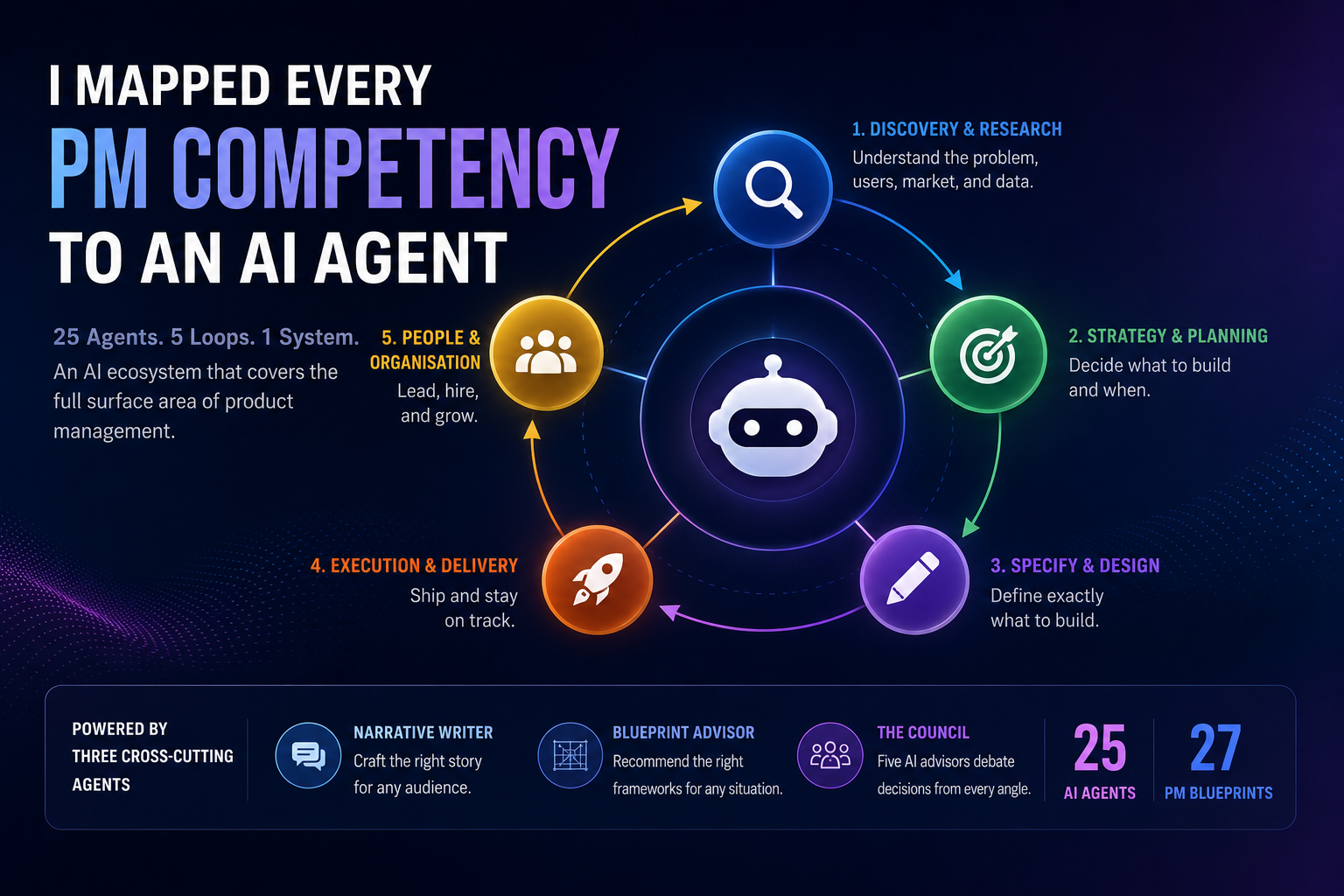
I’m talking about a system. An ecosystem of agents, each with a specific job, that covers the full surface area of PM work — discovery, strategy, specification, execution, people. Agents that don’t just answer questions but operationalise the hard-won frameworks PMs have been using for years.
That’s what I spent a lot of time mapping out. This is the overview.
The Core Insight: PM Work Has Five Loops
Everything a product manager does falls into one of five loops:
- Discovery & Research — understand the problem space, users, market, and data
- Strategy & Planning — decide what to build and when
- Specify & Design — define exactly what to build
- Execution & Delivery — ship and stay on track
- People & Organisation — lead, hire, grow
Every week, you’re running some combination of these loops. The question I asked myself was: which parts of each loop are the most time-consuming but also the most formulaic? Those are the parts an agent can take.
The answer is: a lot of it.
Twenty-Five Agents Across Five Loops
Here’s the structure at a high level.
Discovery: A Customer Insight Synthesiser that turns raw feedback, interview notes, and support tickets into structured themes. A Competitive & Market Analyst that researches the landscape and produces actionable briefs. A Data Storyteller that takes metrics and turns them into narratives your stakeholders can act on.
Strategy: A Strategy Document Writer that structures your thesis into proper strategy docs — choices, trade-offs, success criteria. A Quarterly Planning Agent. A GTM Planner. A Roadmap Narrator that takes a prioritised backlog and writes the stakeholder-facing story around it (not just a Gantt chart).
Specify & Design: A Feature Spec Writer that takes a rough idea and produces a full spec with stories, acceptance criteria, edge cases, and technical considerations. An Experiment Designer. A UX Audit Agent. A Pricing Model Analyzer.
Execution & Delivery: Meeting Prep. Action Extractor. Status Update Writer. Decision Doc Writer. Retrospective Facilitator. Delivery Health Monitor. Each one targets a specific weekly tax on a PM’s time.
People & Org: A 1:1 Coach. An Interview Kit Generator. An Onboarding Guide Generator. A Team Health Assessor.
Plus three cross-cutting agents that work across all loops: a Narrative Writer, a Blueprint Advisor (which recommends which frameworks to apply given a situation), and The Council — five AI advisors that argue about a decision from different angles before a chairman synthesises.
The Real Power: Chains
Individual agents are useful. Chains are transformative.
The meeting loop runs every week without thinking: Meeting Prep brief before you go in → Action Extractor after you come out → actions feed back into next week’s prep. The loop closes.
The planning cycle runs quarterly: OKR Health Check identifies what’s drifting → Quarterly Planning Agent synthesises capacity and priorities → Strategy Doc Writer structures the output → Roadmap Narrator writes the story for stakeholders → Delivery Health Monitor closes the loop back into the next OKR review.
The discovery-to-spec pipeline is the most powerful chain: Customer Insight Synthesiser + Competitive Analyst + Data Storyteller converge their outputs → Strategy Doc Writer builds the case → Feature Spec Writer turns it into buildable requirements → Experiment Designer validates the bet.
The communication stack sits on top of everything else: any agent output → Narrative Writer → Status Update Writer → three versions: exec, team, Slack.
Once these chains are running, the cognitive overhead of PM admin gets dramatically smaller. The hard thinking — the judgement calls, the political navigation, the synthesis — stays yours. The rest gets automated.
The Blueprints Behind the Agents
Each agent isn’t just a prompt. Each one operationalises one or more PM frameworks — what I call blueprints. There are 27 of them covering every major PM competency area.
The Feature Spec Writer operationalises the Feature Specification blueprint. The GTM Planner operationalises the Go-to-Market Strategy, Growth Strategy, Product-Led Growth, and Pricing blueprints simultaneously. The Council operationalises any high-stakes decision framework you’d apply to a major call.
The blueprints are the domain knowledge. The agents are what make that knowledge operational — not something you consult occasionally, but something that runs in the background of your work every day.
What I’m Releasing
I’ve specced all 25 agents. Each spec covers: what the agent does, what blueprints it draws on, what inputs it needs, what outputs it produces, and the exact system prompt design.
The starter pack — including sample agent configs and skills — is already free on GitHub: github.com/nikovijay/pm-ai-skills-kit.
The full package — all 25 agent specs plus the 27 PM blueprints they’re built on — is going out to the list first.
If you want it, sign up below. You’ll get the full blueprint + spec bundle when I release it.
This is the practical toolkit for PMs who want to build the same kind of ecosystem I’ve built. Not theory. Not demos. The actual specs you can load into Claude Code or any agent runtime you’re using.
I’m a Product Director at Booking.com and have been building in this space for 18 years. I write about product, AI systems, and building in public at nikovijay.com.